
The Boardroom Blind Spots
What's costing your business right now.
Most growing businesses are bleeding revenue through the same six gaps. None of them require new hires — they require systems.
Lost Leads
You're paying for traffic that disappears.
Every missed call, slow reply, or dropped follow-up is a paid lead that walked to a competitor. Most businesses lose 30-60% of inbound leads before anyone talks to them.
Repetitive Admin
Your best people are doing data entry.
Scheduling, confirmations, status updates, CRM logging — these are system tasks, not human tasks. Every hour your team spends on them is an hour they're not closing or delivering.
Disconnected Systems
Your tools don't know about each other.
Your CRM doesn't talk to your booking system. Your POS doesn't feed your marketing. Data lives in three places and none of them are right. The gaps cost money and create mistakes.
No Real Visibility
You're making decisions on vibes.
Without real-time dashboards, you're reading last month's numbers to make today's decisions. Revenue, pipeline, capacity — you shouldn't have to dig for any of it.
Expensive Workflows
You're staffing system work at human rates.
Hiring people to do what software should do is one of the most expensive mistakes in a growing business. Automation handles volume; humans handle judgment.
No Feedback Loops
Nobody knows what's working.
Without automated reporting, performance feedback is either manual, delayed, or incomplete. You can't optimize what you can't measure consistently.
Service Tiers
Built for where you are. Designed for where you're going.
Three engagement models. One methodology. The right fit depends on your stage, your team, and how much operational drag you're carrying.
Seed
$1,000-$1,500 setup · $200-$300/moGet the foundation right.
Solo operators and early-stage teams who need automation fundamentals without enterprise overhead.
What we automate
What you get
Optional add-ons
System
$2,500-$3,500 setup · $450-$600/moBuild the machine that runs your business.
Growing businesses ready to systematize their operations and stop losing revenue to manual processes.
What we automate
What you get
Optional add-ons
Studio
$4,500-$6,500 setup · $700-$1,000/moEnterprise-grade intelligence at SMB speed.
Established companies that need custom AI systems, complex integrations, and ongoing strategic partnership.
What we automate
What you get
Optional add-ons
Your Revenue Leak Audit
The Revenue Leak Audit is a structured 48-hour analysis of your lead flow, workflows, CRM, and operational touchpoints. You get a prioritized roadmap of exactly where money is slipping through — and what to fix first.
Missed Follow-Ups
Leads that inquired but never heard back
Workflow Bottlenecks
Manual steps slowing your pipeline
Data Gaps
Missing, stale, or siloed information
Reporting Blindspots
Metrics you can't see in real time
Response Latency
Time between inquiry and first contact
Your numbers
You receive
Case Studies
Real systems. Measurable outcomes.
We document what we build and what it delivers. These aren't estimates — they're results from live deployments.
Security Operations Firm
Challenge
A boutique security firm was managing client intake, scheduling, and shift coordination manually across spreadsheets. Response delays were costing contracts. They needed enterprise-grade operations at SMB speed.
System Deployed
Deployed SENTINEL — a 6-agent automation stack integrating n8n Cloud, HubSpot CRM, and a Telegram-based approval interface. Automated intake, qualification, scheduling, shift alerts, and client reporting.
Outcome
Response time dropped from 4 hours to 11 minutes. Lead conversion improved significantly. The ops team reclaimed 22 hours per week for higher-value work.
Results
Wellness Studio Chain
Challenge
A 3-location wellness studio was losing 40% of inbound calls to voicemail with no follow-up system. Booking was manual and inconsistent across locations.
System Deployed
Built missed call recovery agent, automated appointment confirmation sequences, and a live cross-location dashboard tracking bookings, revenue, and capacity utilization.
Outcome
Recovered 38% of previously lost leads within 60 days. Booking volume increased across all three locations. Staff admin time dropped by 14 hours per week.
Results
Independent Consulting Practice
Challenge
A solo consultant was spending 8+ hours per week on scheduling, proposal follow-up, and client reporting — time that should have been billable.
System Deployed
Automated intake-to-proposal workflow, scheduled follow-up sequences, and a simple automated weekly client digest pulling from project notes.
Outcome
8 hours per week reclaimed immediately. Proposal follow-through rate increased by 45%. Client satisfaction improved with consistent, timely updates.
Results
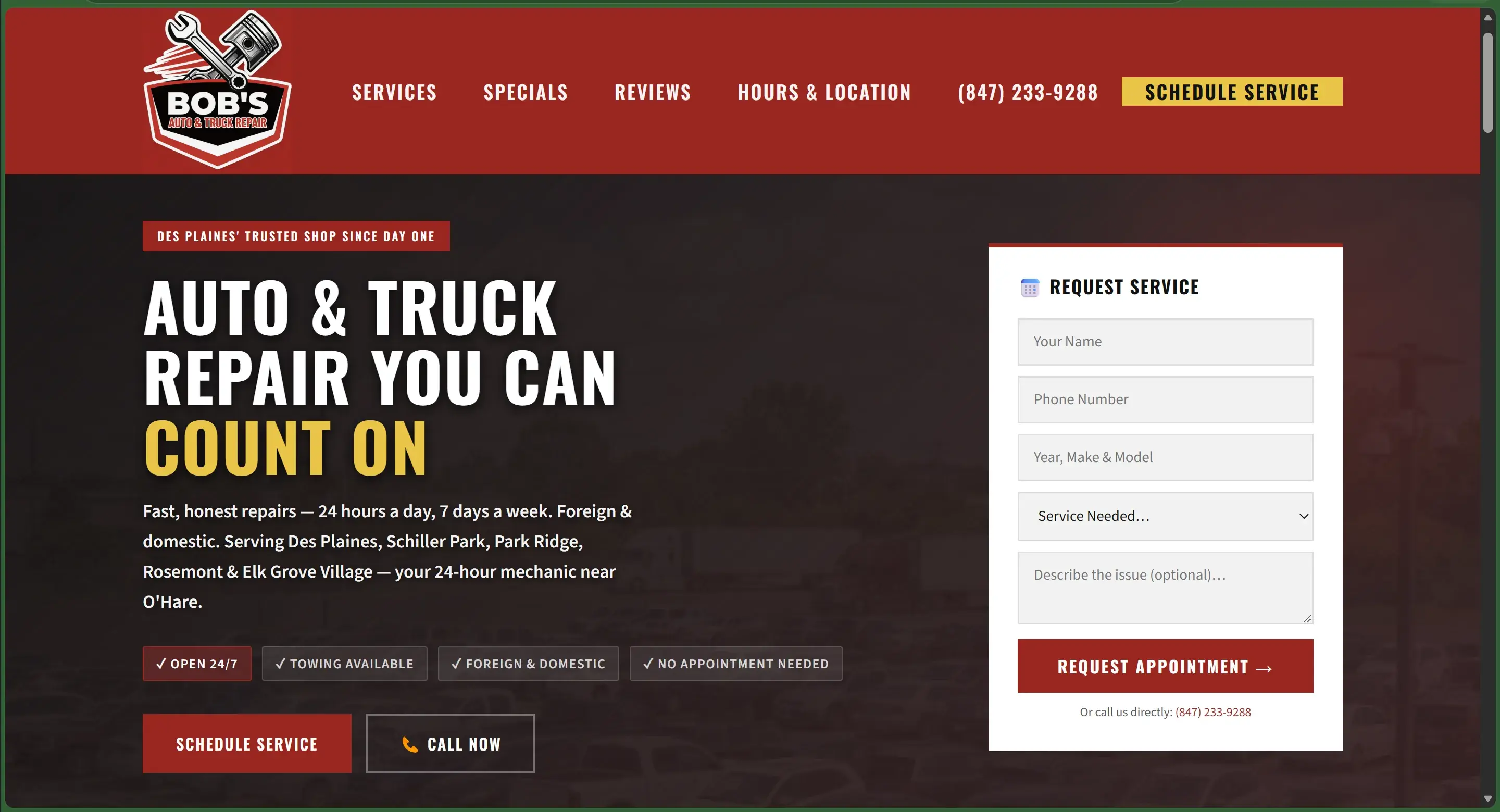
Bob's Auto & Truck Repair
Challenge
A 24/7 auto shop near O'Hare needed more than a web presence — it needed to actively compete across five suburban markets and give people a concrete reason to choose Bob's over the shop they already knew. The site had to work as hard as the shop did.
System Deployed
Single-page site built with local SEO architecture, schema markup, Google and Yelp review integration, and a no-friction appointment scheduling form wired directly into shop operations — reducing phone tag and letting customers book at any hour without staff involvement. The key strategic layer: a site coupon — conceived and built in as a conversion mechanism — giving new visitors a tangible reason to act and the shop a direct, trackable attribution signal for every web-driven visit.
Outcome
Over a dozen new customers walked in during the first week alone, each specifically citing the site coupon — clean, direct attribution to the build. The online scheduler immediately reduced front-desk call volume and allowed the shop to capture after-hours bookings that would have otherwise been lost. Now running a 4.8-star Google rating with 207+ reviews and consistent organic reach across five suburban markets.
Results
How We Work
From signal to optimized system.
A disciplined five-step methodology. No guessing, no scope creep, no hand-waving. You know exactly where we are and what comes next.
Signal
Audit
Blueprint
Deploy
Optimize
Step 1 of 5
Signal
We identify where revenue is slipping, where time is being wasted, and where your systems aren't talking to each other.
Signal
We identify where revenue is slipping, where time is being wasted, and where your systems aren't talking to each other.
Audit
A structured 48-hour deep dive into your workflows, CRM, lead flow, and operational gaps — delivered as a prioritized action map.
Blueprint
We design the exact automation architecture that fits your business model, team size, and growth stage.
Deploy
Hands-on build and integration. We handle the technical lift so your team stays focused on what matters.
Optimize
Systems evolve. We monitor performance, catch drift, and tune your stack as your business scales.
Founding Partner Engagements
A limited number of strategic onboarding slots at reduced investment.
Founding partnerships are for businesses ready to move. Discovery call required.
Who We Work With
Is this built for you?
We specialize in specific business types where automation ROI is fastest and most predictable.
Wellness & Health
Common pain points
Recommended workflows
Local Services
Common pain points
Recommended workflows
Consultants & Agencies
Common pain points
Recommended workflows
Auto & Trade
Common pain points
Recommended workflows
Sales Teams
Common pain points
Recommended workflows
Find Your Fit
Where should you start?
Answer eight questions. Get a recommended tier, projected ROI, payback period, and your best workflows.
Where are leads most likely leaking?
Ready to stop paying humans for system work?
One discovery call. We map your operation, identify the leaks, and show you exactly what an automation stack would deliver. No obligation. No pitch deck. Just the truth about your business.